The Jackie Kennedy Triple Strand Pearl Necklace
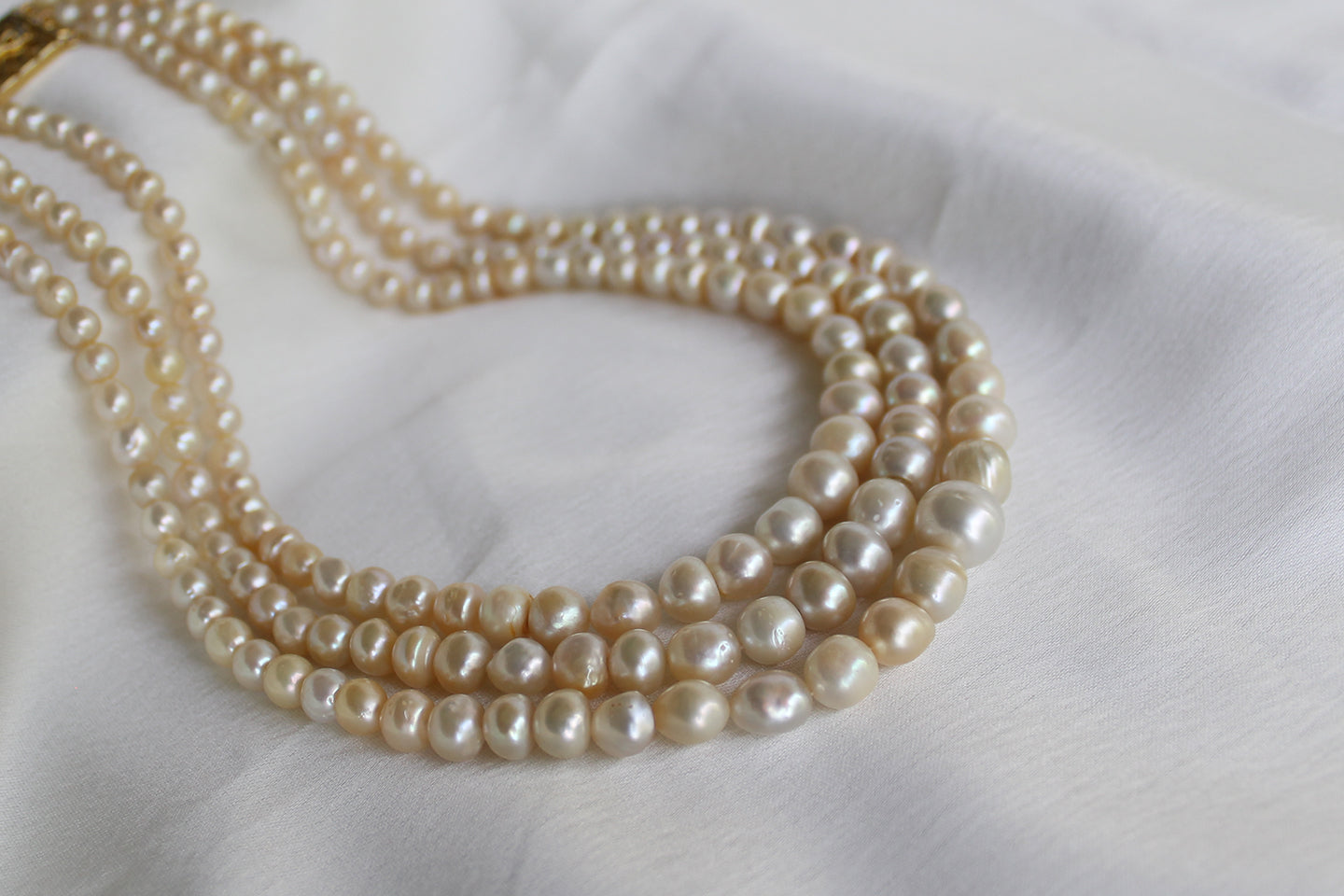
The most well-known pearl necklace was that which was worn by the American First Lady Jacqueline Kennedy. She was the very definition of chic. The triple strand pearl necklace was shown in the 1962 Cecil Stoughton photograph of Jackie holding her young son John. The boy pulls one of the strands high over her chin, as she tosses her head back and smiles. It was one of the most seductive photographs in American memory. It made the three strand pearl necklace so famous that it was copied endlessly.
Funnily enough, the pearl necklace was not even made of cultured pearls but of faux (or simulated) pearls, hand-painted glass beads to be precise, or costume jewelry if you prefer. All the same, it was one of her favorite jewels, and she wore it almost every day.
Also read: All You Need To Know About the History of Choker Necklace
This iconic image of John, Jacqueline and Caroline Kennedy was captured by Jacques Lowe, Kennedy’s personal photographer, during his first photo shoot with the family in Hyannis Port, Mass., in July 1958. (Estate of Jacques Lowe)
Maisie’s Pearl Necklace and the Story of the Cartier Mansion

The Cartier Mansion in 1920
It's possible to walk by the Cartier Mansion, on the corner of 52nd Street and Fifth Avenue (653 Fifth Avenue) in New York City, without much of an idea of what it represents-in addition to having been the New York home of Cartier since 1917, it's also one of the last remnants of a long-gone world that exists now only in fragments, along a stretch of Fifth Avenue that used to be home to some of America's wealthiest and most powerful families.
The original owner of the house was an American businessman named Morton F. Plant, who had made a fortune in the railways. When his first wife died, the 61-year old Morton was married again – to the 31-year old Mae Caldwell Manwaring. Mae Caldwell Manwaring became Maisie Plant in 1914, and promptly moved into the premises at 653 Fifth Avenue.
At that time, Cartier had set up shop in New York was 712 Fifth Avenue (on the west side, at 56th street). Mrs. Plant set her heart for an elegant pearl necklace that had been exhibited by Cartier at its 712 Fifth Avenue address. It was really two pearl necklaces: a double strand of enormous, natural South Sea pearls; the smaller is a strand of 55 pearls and the larger, of 73. The two together were worth $1 million – in 1917 artificial pearls and not yet reached the market, and creating a graduated set of flawless, large pearls took a lot of time and a lot of money. Mrs. Plant wanted the pearls, so a deal was struck.
Portrait of Mrs. Mae Caldwell Manwaring Plant, by Claudia Munro Kerr, from an original by Alphonse Junger
Mr. Plant offered Cartier his house and a sum of 100 dollars in exchange for the two lines of pearls. Thus, Mrs. Plant got her pearls, and Cartier found its iconic home in New York. The building has landmark status in New York City and still looks substantially as it did when Cartier acquired it.
The pearl necklace would sell for only $181,000 – they had, in fact, fallen precipitously in value just a few years after Mrs. Plant was given them, thanks to Kokichi Mikimoto's introduction of cultured pearls in 1916. After having been sold at auction for a fraction of their original value, they appear to have vanished off the face of the earth. No one seems to have any idea where they ended up; the two strands may have become separated, or even broken up so the pearls could be used in other pieces. But if they're intact somewhere – half-forgotten in a vault, or overlooked in someone's vast-but-disorganized collection – then someone is in possession, nearly a century after Mrs. Plant first wore them, of the single greatest piece of Cartier memorabilia of all time.
The Seven Strand Baroda Pearl Necklace
The seven-stranded Baroda Pearl Necklace, was the most expensive piece of jewelry in the fabulous collection that once belonged to Maharajah Khande Rao Gaekwad of Baroda. The original Baroda Pearl Necklace that was commissioned by Maharajah Khande Rao Gaekwad during the early years of his 14-year rule, between 1856 and 1870, was made up of seven strands of matching pearls in terms of size, shape, color, luster and surface quality. The shape of the pearls were spherical or near-spherical and the color was white. The pearls were apparently blemish-free, or contained minor blemishes not visible to the naked eye. The luster of the pearls were extraordinary in keeping with the good quality nacre that was thick and translucent. Little wonder that the luster of these pearls had remained undiminished during the last 150 years.
In 1946, most of the Baroda Crown Jewels, including four celebrated pearl carpets, the famed seven-strand pearl necklace amongst a lot of other important pieces were carried to the Monaco residence by Maharaja Pratapsingh Rao Gaekwad and his second wife Sita Devi. After independence, when it was eventually returned to India, the Baroda Pearl Necklace was reduced to six strands, from its original seven. It is not known whether it was the shortest or longest strand of the necklace that was missing. The Baroda Pearl Necklace thus became part of the crown jewels of Baroda again and was kept in the Lakshmi Vilas Palace, the official residence of the royal family of Baroda.
The fate of the Baroda Pearl Necklace since then is not known, but a two-stranded pearl necklace reconstituted from selected pearls of the original Baroda Pearl Necklace, suddenly made it appearance at a Christie's auction in New York in April 2007, and set a world record price of $7.1 million, the highest ever realized by a pearl necklace at an auction.
The reconstituted two strand Baroda pearl necklace
Barbara Hutton/ Marie Antoinette Pearl Necklace
Barbara Hutton was born in 1912 in New York and was the daughter of Frank Woolworth of the retail stores fame. Being born into a family of immense wealth, she enjoyed a very lavish lifestyle and in 1933 she married Prince Alexis Mdivani in Paris.
The historically important pearl necklace that had formerly been worn by Marie Antoinette, Queen of France. Bought from Cartier, Paris, this jewel was given to Barbara by her father as a wedding present on the occasion of her marriage.
The jewel, which the press described as “one of the rarest strands of pearls ever sold by Cartier” became one of Barbara’s most cherished possessions. Cartier later created a black opal and diamond clasp on Barbara’s commission. She was so fond of the pearl necklace that she wore it during the day and at night, and had its length adjusted according to the vagaries of fashion.
After a whirlwind of a life, she died in 1979 with very little money but her will revealed that she had retained many of her most important jewels.
When the pearl necklace eventually sold in 1992, it comprised 40 pearls, but Cartier’s records confirmed that it had been restrung and altered many times for their valued client.
References:
20th Century Jewelry & the Icons of Style by Stefano Papi and Alexandra Rhodes